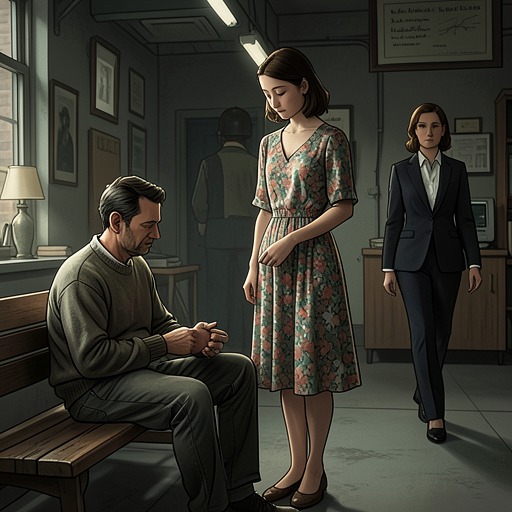
Tova’s refusal to date after Will’s death
Remarkably Bright CreaturesTova Sullivan’s refusal to date after Will Sullivan’s death shapes how she names her relationship with Ethan Mack and how she imagines the years ahead. She repeatedly insists that supper is not a date, and tells Janice Kim that she cannot date after a forty-seven-year marriage. The rule is clear in its wording, but the conversations around it expose the pressure beneath it: loyalty to Will, uncertainty about what companionship with Ethan means, and Tova’s conviction that accepting care would burden the people around her.
The Rule in Practice
On a Saturday evening, Tova arrives at Ethan’s house carrying a bottle of wine. She handles it carefully, tucked in the crook of her arm, unlike Barbara Vanderhoof, who had presented it by the neck while calling it a bottle to bring on a date. Tova has corrected that description repeatedly. To her, the invitation is no more than supper, and a quick one at that: she has said she needs the time to pack for her move.
That practical explanation is only part of the picture. Tova’s free time has also been taken up searching library volumes for information about Daphne Cassmore, though the research has stalled and yielded little useful information. She asks herself what harm there could be in taking an evening away from that work to share a meal with a friend, then hesitates over whether Ethan is her friend. Her insistence that the meal is not a date sits alongside this uncertainty, rather than resolving it. The distinction matters to her even as the question of what their connection is remains open.
The denial recurs when Cameron Cassmore asks how Ethan’s date went. Tova straightens and corrects him: it was not a date. When Cameron changes the word to dinner, she does not let the exchange settle into simple agreement. She explains that she and Will were married for forty-seven years before he died, and that she cannot date. The rule is therefore more than a label for one evening; Tova presents it as a consequence of the life she shared with Will.
Marriage, Loyalty, and Ethan
Tova’s answer to Cameron invokes the length and finality of her marriage, not a complaint about Ethan. Later, when Janice raises Ethan by name, Tova calls him a wonderful man but begins to place that possibility beside her marriage to Will: Ethan is wonderful, but she and Will were—. She leaves the thought unfinished in the exchange. The interruption does not erase what she has said; it makes visible the difficulty of completing the comparison.
Janice frames the issue differently. She says Ethan is deeply taken with Tova and asks why Tova cannot give him a chance. Tova does not answer by disputing Janice’s description of Ethan or by denying his appeal. Instead, her incomplete reply returns to Will. The evidence thus holds two facts in tension: Tova regards Ethan warmly, while treating dating him as incompatible with the marriage and bereavement that define her boundary. It does not establish that the two are dating, or that Tova has decided to change her mind.
Her repeated correction also has a social dimension. Other people interpret the supper as a date and present that interpretation to her; Tova’s insistence restores her own account of the evening. The repetition communicates how firmly she wants the distinction maintained, even as her uncertainty about calling Ethan a friend and her attention to his feelings complicate any simple claim that she is indifferent to him.
Janice’s Challenge and Tova’s Reasons
Janice urges Tova to reconsider. She argues that their later years need not be spent among strangers and asks what will become of their friendship if Tova moves away. When she brings up Ethan, Tova starts to respond but cannot immediately find the words. She gives a short chuckle at Janice’s suggestion that people in their seventies still have decades ahead, yet the moment of humor does not amount to agreement. Janice presses her to see the move as one possible choice rather than the only one.
Tova’s defense of that choice turns on care. She says she has no children who will come to stay after a fall, no grandchildren who will stop by to unclog a drain or check that she is taking her pills, and no wish to place that responsibility on friends and neighbors. Her reasoning reaches beyond dating: she connects her future living arrangements to the support she expects to need and the burden she fears imposing. In this conversation, her reluctance to depend on others is part of the same outlook that makes intimacy difficult to accept.
Janice answers that Tova is assuming such help would be a burden. That reply challenges the premise beneath Tova’s reasoning without resolving the disagreement. Tova does not retract her concern, and the exchange supplies no final decision about either her move or Ethan. The refusal is presented as a position she can articulate and defend, but also as one her closest friend believes deserves reconsideration.
What the Refusal Reveals
Tova’s rule draws a boundary between companionship and romance at a moment when that boundary is being tested by ordinary gestures: a shared meal, a bottle of wine, and other people’s assumption that the evening is a date. Her language keeps the event modest and defined, while the people around her read it as evidence of a possible relationship. The difference between those accounts gives the refusal its force without proving that Tova’s feelings have changed.
The exchange also links autonomy to vulnerability. Tova insists that she cannot date, yet when she explains her plans she speaks not only of her marriage but of falls, household repairs, medication, and the limits of the help she believes she can ask from friends. Janice’s response offers a competing interpretation: assistance need not be a burden. The scene leaves that possibility in conversation rather than converting it into a resolution. Tova’s refusal remains real, but its stated reasons place it within a wider question of whether she can accept companionship and care without treating either as a betrayal of Will or an imposition on others.